
Beyond borders CAMP 2024 Tanzania Expedition (2024)
【Project Activities】
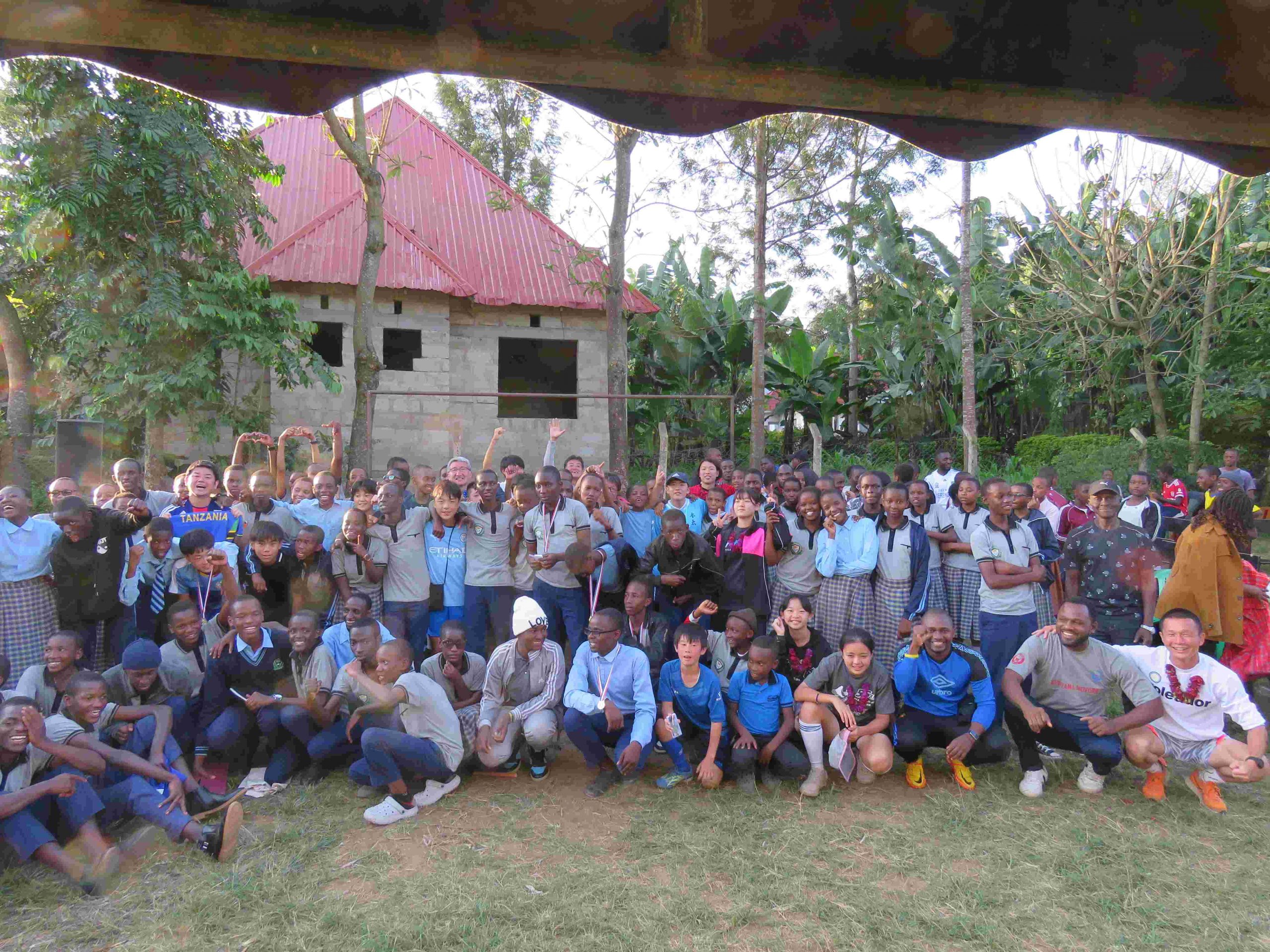
‘- TAJA (Tanzania & Japan) Soccer Festival: Four teams consisting of mixed Tanzanian and Japanese participants were formed. A soccer tournament was held over two days for these four teams.- Visit & Stay in Maasai Village: Experienced the life of the Maasai people, who continue to coexist with nature, by visiting and staying in their village.- Visit Tarangire National Park: Experienced a world of diverse animals and plants, realizing that the Earth is not only a place for humans.- Visit Local Junior High School: Visited a local junior high school to interact with peers of the same generation. Conducted cultural exchange by teaching each other Japanese origami and Tanzanian beads, and sports exchange through soccer and frisbee.
【Project Background】
Under the concept of increasing the “total amount of connections” in the world through soccer to break the chain of existing discrimination and division, the overseas expedition project (Beyond borders CAMP) began in 2022. The aim is for young people who will lead the next generation to experience “human connections” and “connections with the world,” thereby broadening their values and perspectives, through a one-week program that includes soccer tournaments with local peers, experiences of local life, and exposure to cultural and social issues. This project has been continuously implemented in Cambodia and Nepal.
【Project Objective】
1. To experience essential “human connections” that transcend nationality, religion, and language through soccer.
2. To understand the world not through fragmented knowledge but as a single connection between “oneself,” “one’s comrades,” and “the world of those comrades,” thereby realizing “one’s connection to the world” by glimpsing the lives of comrades connected through soccer.
【Project Area】
Peacebuilding through sport
【Methods】
Human Resource Development
【Outcomes】
1. Many participants were able to feel “human connections” that transcended nationality and language through soccer.
2. By experiencing environments different from their own, participants had an opportunity to reflect on “themselves” and “Japan” and to view the world from multiple perspectives.
【Voices from Participants and Partners】
• “At first, I thought it would be impossible to get along with people from different cultures and languages, but we could connect through soccer.”
• “There were various people, some playing on imperfect soccer fields or barefoot, but we connected through soccer.”
• “I’ve heard of racial discrimination against Black people. But when I played soccer with the locals, I didn’t care about skin color one bit. Even with different languages and skin colors, you can play soccer with just one ball!”
• “When playing soccer, I couldn’t understand the language, and the field wasn’t clean, so I was worried about what to do, but as we played, I somehow understood, and it was reassuring.”
• “I realized that even in countries whose names I didn’t know, there were many people who loved soccer and jumped at the ball, and that you could enjoy it even if you couldn’t understand the language. That’s soccer!”
• “I learned what I lacked, both in soccer and socially, about myself and Japan. I will strive to compensate for my shortcomings and become a perfect adult.”
• “Tanzanians speak Swahili as their official language, but they can also speak English fluently. I realized that despite the poor environment, the educational standards are very high. Japanese people are in a good environment, but it’s a waste. I decided to study hard to become fluent in English when I return to Japan.”
• “I thought I could just rely on others because I didn’t understand English at all, but when I tried asking using only the words I knew, it surprisingly worked. This taught me the importance of trying things for myself.”
• “What I feel I’ve grown in is taking on challenges. I couldn’t eat the local food at first, but I gradually managed to. And I could speak a little English. Even if I couldn’t understand, I tried my best to listen, and even if they couldn’t understand me, I could communicate with gestures. Seeing a goat killed in front of me in the Maasai village, I realized how the meat and fish I always eat come to me, and I learned to appreciate life.”
• “Seeing a goat killed and suffering in front of me in the Maasai village made me feel the preciousness of life.”
• “It was a lot of fun meeting various Japanese and Tanzanian people through this expedition.”
• “Being rich is a great happiness for Japanese people. However, Tanzanians are all smiling even without money. I learned that love is more important than money.”
• “I once again felt how vast the Earth is. The horizon stretched endlessly. My worries seemed insignificant.”
• “I realized that the food I eat at home isn’t something to be taken for granted, and I became aware of the amazingness of Japanese food. Eating with gratitude, I thought, is the most important thing.”
• “I experienced a world that cannot be known through tourist visits, and it was a very good experience.”
• “Coming to Tanzania also allowed me to appreciate the good things about Japan.”
• “I thought there were many things Japan should learn, such as genuinely appreciating food and not using plastic bags.”
【Challenges and Lessons Learned】
1. To increase the intensity of exchange, the soccer tournament was structured as a serious competition among four teams. As a result, the focus on winning became too strong, and for some participants, “competing” seemed to take precedence over “connecting.”
2. During a visit to a local junior high school, when there was a long period of free time, some children appeared confused and unsure how to interact with each other. This highlighted that merely “being in the same space” does not necessarily lead to “exchange,” and underscored the importance of designing opportunities that foster more natural dialogue and interaction.
【URL】
- Time Period
- July 31, 2024 - August 9, 2024
- Region
- Tanzania
- Sport/Programme Category
- Soccer
- Implementer
- Seeds General Incorporated Association
- Co-Implementer
- NGO TOFA, GMSS Co., Ltd.
- Number of Individual Beneficiaries
- Tanzania: 100, Japan: 17